
En el cruce entre tecnología y política, el cambio es permanente. Para quienes trabajamos en esta intersección, aprender es parte del trabajo: entender sistemas complejos, explicarlos de forma accesible, y ayudar a construir políticas públicas que hagan que su impacto sea positivo, democrático e inclusivo.
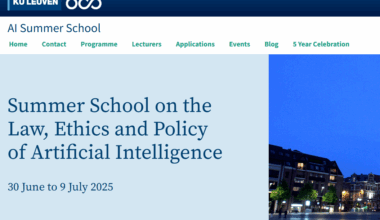
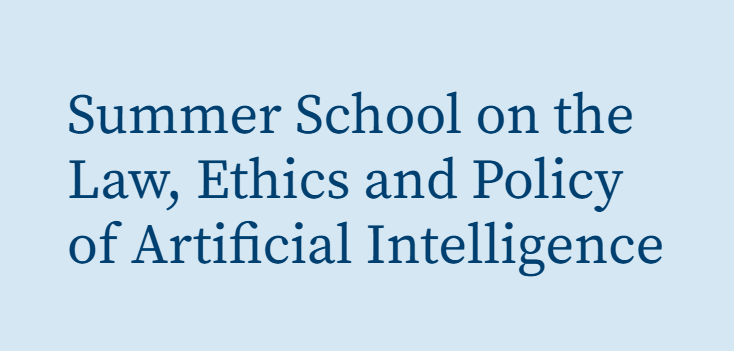
Mi paso más reciente fue la AI Summer School on Law, Ethics and Politics of AI, organizada por el Centre for IT & IP Law (CiTiP) de la Universidad KU Leuven, en Bélgica. Un programa intensivo, ambicioso y riguroso, que reunió a personas de diversas disciplinas para pensar juntas cómo desarrollar, investigar y regular la inteligencia artificial con un enfoque centrado en los derechos humanos, la justicia social y la democracia.
_
At the intersection of technology and politics, change is constant. For those of us working in this space, learning is part of the job: understanding complex systems, translating them into public language, and participating in policymaking to shape their impact into something democratic, inclusive, and socially just.
My most recent step was attending the AI Summer School on Law, Ethics and Politics of AI, hosted by the Centre for IT & IP Law (CiTiP) at KU Leuven in Belgium. An ambitious, high-level program that brought together professionals from diverse disciplines to reflect on how to develop, research, and regulate AI from a people-centered, rights-based, and democratic perspective.
_
Durante diez días de seminarios, clases y debates, abordamos los principales dilemas de la gobernanza de la inteligencia artificial a través de múltiples lentes: jurídico, ético, técnico y político. Algunos de los ejes que exploramos:
-
Derecho y regulación de la IA: analizamos las implicancias del AI Act de la Unión Europea, las propuestas de regulación en América del Norte y Asia, y los desafíos para países del Sur Global.
Law and AI regulation: we explored the implications of the EU AI Act, regulatory proposals in North America and Asia, and the specific challenges for the Global South. -
Responsabilidad y justicia algorítmica: discutimos la opacidad de los sistemas automatizados, la responsabilidad civil y penal, y los mecanismos de rendición de cuentas.
Accountability and algorithmic justice: we analyzed opacity in automated systems, civil and criminal liability, and accountability mechanisms. -
Ética y derechos humanos: ¿cómo garantizar que la IA respete la dignidad, la igualdad y la no discriminación? ¿Qué principios deben guiar su desarrollo?
Ethics and human rights: how can AI respect dignity, equality, and non-discrimination? What principles should guide its design and deployment? -
Impacto social y geopolítico de la IA: ¿quién produce, quién regula y quién se beneficia de los sistemas inteligentes? ¿Cómo se configuran las asimetrías de poder global?
Social and geopolitical impact of AI: who builds, who governs, and who benefits from intelligent systems? What global power asymmetries are being reinforced? -
Interdisciplinariedad: aprendimos a dialogar entre saberes técnicos, jurídicos, filosóficos y sociales, entendiendo que la IA no es solo un asunto de ingenieros, sino de toda la sociedad.
Interdisciplinarity: we learned to bridge technical, legal, philosophical, and social fields, recognizing that AI is not just a matter for engineers — it concerns all of society.